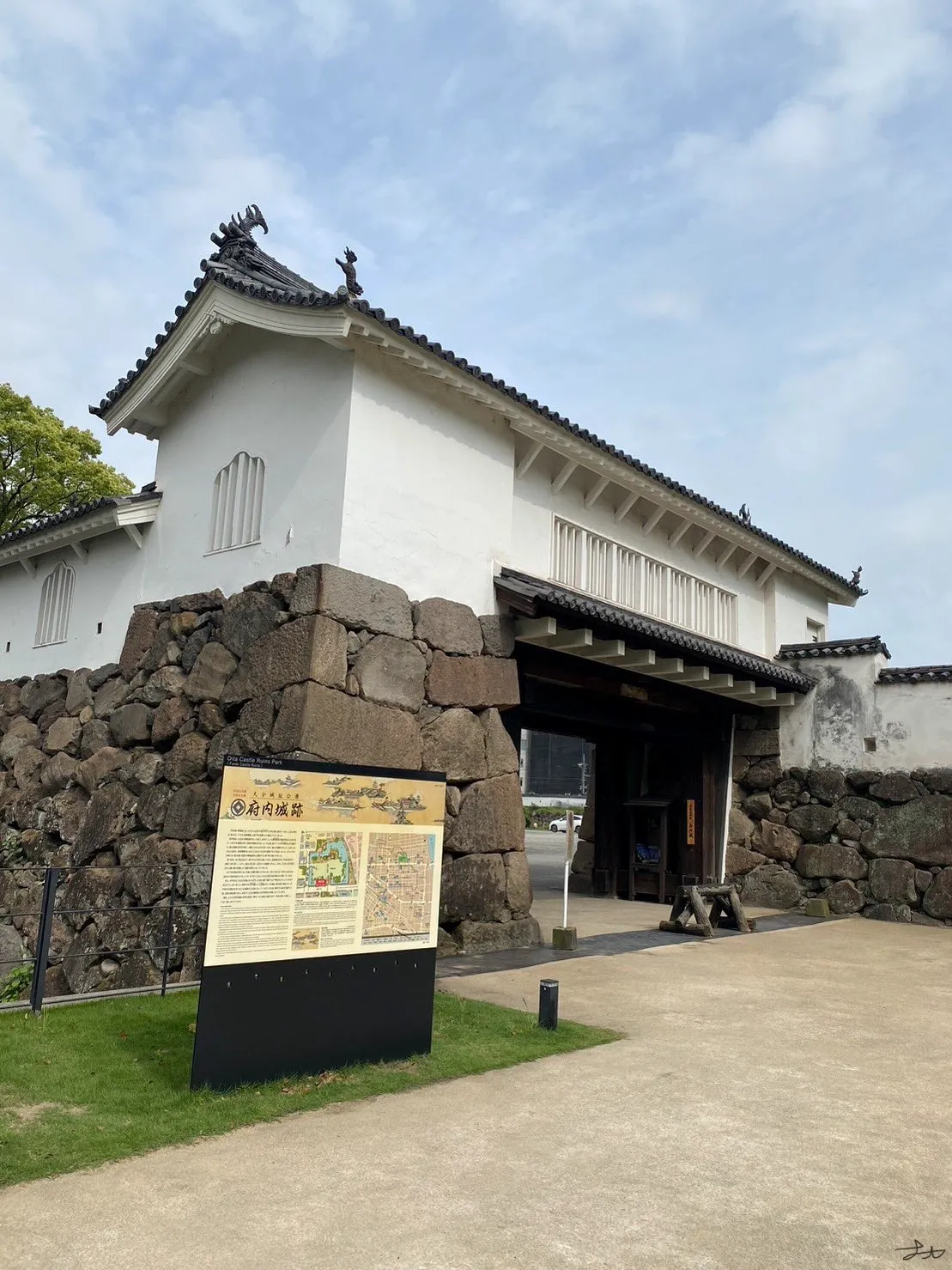
Funai Castle (Oita) Audio Guide
Funai Castle once faced the sea between the Oita River and the Sumiyoshi River. Today it is a compact and practical castle site where the Otemon Gate, corridor bridge, turrets, and stone base can be visited efficiently, especially in the morning or late afternoon around an overnight stay in Oita.
Tap a button to hear the section.
Overview
Overview
Funai Castle is an early modern castle built by Fukuhara Naotaka in 1597. It stood between the Oita River and the Sumiyoshi River and once also faced the sea, which gives the site a partly maritime character. Today it survives as Oita Castle Ruins Park in the middle of the city, where visitors can still recognize important remains such as the Otemon Gate, corridor bridge, turrets, stone walls, and the main keep base. Unlike a large mountain castle, Funai Castle is easy to understand in a short visit because its major elements are concentrated within a compact area. That makes it especially useful as a castle to combine with an overnight stop in Oita during a broader tour through Bungo and Buzen.
Access
Access
Funai Castle is about a fifteen-minute walk from JR Oita Station and sits in a very accessible urban setting. If you arrive after visiting Saiki Castle, the drive north takes roughly an hour and a half, which fits well with a later-day stop in Oita. Approaching from the corridor bridge side gives you one of the most castle-like first impressions, but it can make the Top 100 Castles stamp slightly harder to locate at first. The stamp is under the Otemon Gate, so if you enter with that relationship in mind, the layout becomes much clearer. Walking around the outer edge of the ruins is easy, and the riverside setting helps explain why this was not just a city park, but a castle site shaped by water and transport.
Parking
Parking
For sightseeing only, the official guidance says to use nearby parking rather than a dedicated tourist lot inside the ruins. City parking around Oita City Hall and nearby paid lots are the practical options. The Top 100 Castles stamp is installed under the Otemon Gate and can be stamped 24 hours a day. The corridor bridge itself can generally be visited from around 8:00 a.m. to about 6:00 p.m., so it is worth paying attention to that time window if you want to cross it and photograph the approach. Admission is free, which makes the site well suited to short visits before check-in, after breakfast, or between longer castle stops. Because some cars may be parked in the open plaza area, the atmosphere is a little different from a purely preserved castle park, and that modern urban character is part of the site today.
Highlights
Highlights
The first feature to notice is the combination of the Otemon Gate and the covered corridor bridge. Entering through the Otemon Gate immediately creates a strong castle atmosphere, while the view from the bridge side is one of the best photo angles at Funai Castle. The site is not overly large, so the turrets, corridor bridge, and main keep base can all be seen efficiently in a short circuit. If you keep in mind that the castle once stood between two rivers and also faced the sea, the defensive and logistical importance of the setting becomes much easier to understand. The main keep base still works well as the emotional center of the ruins even though the keep itself no longer survives. Walking the perimeter also highlights the balanced, practical beauty of an early modern flatland castle. It is a castle that rewards quick visits, but morning and evening light can change its character noticeably, which is why it works especially well as part of an overnight stay in Oita.